Friday, 28 October 2011

Neon Nights and Katsu Curry: channeling your inner salaryman

Heated toilet seats and wet-room showers. Endless vending machines and the cacophonous siren call of shop assistants and storefront jingles. These are the things that remind me of the wonder of Tokyo.


I lived in Tokyo from 1989 to 1994, during it's heyday some might say. As a gloriously carefree expat brat, Tokyo was the ultimate playground - a neon wonka fun factory where the noise never dulled and threats never surfaced. It is a wondrous land of contradiction. It is both the safest place I have ever lived and the most morally twisted. The Japanese are a fascinating cocktail of stoic traditionalism and bug-eyed lunacy. I went back after finishing university in 2001 for a year off, studying Japanese in the mornings, teaching English at night and DJing on the weekends. It was one of the best years of my life, and the city will forever feel like my second home. London is the only other city in the world where I feel as much in my element, and even today there are indelible shards of Japanese culture nestled within my rambling psyche.

So it is with enormous joy and nostalgic excitement that I get to return there occasionally for work. Flippant reports about godzilla and mega-radiation never dampen my enthusiasm for the place, and even though the whole experience is framed within the breathless agenda of a business trip, this is a city full of surprises.

My first stop was an old favourite from when we lived there, a family-run tonkatsu restaurant called Tonki's. Nestled down an alley (like everything in Tokyo), it's as unassuming as they come. When you step through the sliding doors however, you are in for a treat. The sweet, crispy aroma of freshly frying tonkatsu wafts through the air, cushioned by the chatter of the patrons sat at the bar and the hushed awe of those watching the family ply their trade. They are hushed, because they have a bird's eye view of the entire kitchen. Each station is manned by various generations of the same family, and they all work flawlessly in unison: a well-oiled machine with incredible speed and disciplined attention to detail. The best thing about this? They only serve two dishes: pork fillet, or pork chop. That's it. And they haven't changed in decades.


The father greets you as you come in, takes your order and memorizes your face. The youngest guys egg and batter the pork fillets. The elder sons manage the fryers, gently dipping the katsu into huge copper vats. The grandfather awaits the freshly fried katsu with a razor sharp blade, and with fingers like blushing cherries he grabs the cutlet and slices it into perfectly formed pieces. If you've ever tried to slice tonkatsu just after frying it, you'll have discovered as I did that it is a) hotter than hades and 2) incredibly hard to slice neatly. The man is an absolute master at this one very specific task, just like the rest of the family. Each person has a role that they have mastered completely, no matter the significance. Two more staff then plate everything and attend to refilling the diners' plates with steaming rice and crispy fresh cabbage.

Beautifully simple and expertly crafted. 
Like very few other places I can think of, Tonki's has an atmosphere that really is just hard to express in words. You sit at the bar, take a load off, and watch this family craft your meal from start to finish without any drama, fuss or commotion. It arrives on your plate accompanied with a small dish of pickles and the best miso soup you'll never get in London. My colleague who had braved the journey with me, jetlagged to the gills like myself, was entranced by the place and wolfed down his meal with blissful gusto. For me, it was a uniquely surreal experience, finally going back after nearly ten years. Seeing all the same family members attending the same tasks was like stepping through a timewarp to one of the happiest periods of my childhood. Being there with a colleague from my life now, having come so far since my life in Tokyo, was like having the most nostalgic experience ever and then discovering that you can still enjoy it today. I will definitely go back the next time I am out east.

The rest of the trip was a frantic sprint between meetings, hotel buffets and crazed meals around the city. It's incredible seeing how much stuff the Japanese have managed to cram into this dense metropolis. We found a shop that was literally situated in a staircase. We stopped in an underground bar that played jazz remixes of Disney theme tunes. I met up with an old family friend at the smallest yakitori restaurant ever built (eight chairs around a bar). Everything is on multiple floors and basements, with drinking dens, cafes, boutiques, hairdressers and hostess bars all sharing vertical real estate. It is a swarming rabbit warren of activity, with surprises lurking on every floor.

I could write pages and pages on my love for Tokyo and all the strange things I have encountered there. But for me, what I thought would be slightly more useful and interesting would be to put down a recipe for something that will always, always take me back to Japan in a second: katsu curry.

Katsu curry is a stalwart of the salaryman. If you've ever been to Tokyo and witnessed the black and white tsunami of downtown rush-hour, you will know what I'm talking about. Millions upon millions of office workers, clerks and attendants, all suited, and all eating in little stand-up noodle bars and curry houses. Katsu curry is a particular mainstay, alongside tempura udon/soba for people who need to eat, and eat well, in a hurry. Outside every train station in Tokyo you will find a handful of these places, where you pop in, get a food token from the cash machine, plonk it down at the counter and receive a steaming bowl of food in return. It is glorious in its simplicity, and the realisation that this is, in effect, fast food. It goes without saying, however, that fast food done by the Japanese is unlike anything you'll ever encounter at the Fast Chicken Cottage in Hackney (speaking of which, Japanese KFC is amazing).

Self-Serve all-you-can-drink bar. Utter carnage.
The nicest katsu curry I have come across in central london can be found at Ten Ten Tei, on Brewer Street in Soho. Wagamama's can probably be attributed with bringing katsu curry to the masses, but I find their version too plasticky and dry, a real low-budget manufactured version. Ten Ten Tei's at least doesn't taste like it's been microwaved in a sachet. Naturally then, I decided to try making it myself at home. Japanese food, by and large, I find rather intimidating due to it's exotic ingredients and incredibly strict cooking guidelines. It's generally a very delicate cuisine, and not one that I've ever found anywhere near as accessible as chinese or mexican. Thankfully however, I can reassure you that katsu curry is one of the easiest and simplest japanese dishes you can find. It's hardly gourmet cooking, but then if you've read this blog before you'll know that's not what I'm going for anyway. The next time you're in the mood for it, grab a couple of the specific ingredients from a japanese/oriental shop, some pork loins and give this a whirl - you will be amazed at the difference.

Katsu Curry at Home
Ingredients:

150 g of pork loin
1 cup of panko breadcrumbs
1/2 cup of flour
1 medium egg (beaten)
Japanese curry sauce mix
+ however much boiling water the sauce mix requires
200ml chicken stock
2 large potatoes, cubed
1 medium sized carrot, sliced
2-3 medium yellow onions
2 tablespoons of garlic
1 green pepper (optional)
2 cups of rice
2 tablespoons of pickled red radish
vegetable oil
Salt & Pepper

For the Curry Sauce mix, you can get packets of this stuff in any Japanese food store - my preference is for the medium hot packets, but there are hotter or milder versions available. If you're not sure which brand to get (they're all pretty much the same), just ask one of the staff members and they can happily assist.

Fry a couple of cloves of garlic in vegetable oil and slice up the vegetables. Gently fry the onions until they have wilted and are translucent. Add the sliced carrot and the potato and cook for a few minutes. Add the chicken stock and however much water the curry sauce mix requires and bring to a simmer. Once the water is boiling, add a packet of the curry sauce mix (usually half of the packet), and reduce to the lowest heat. Mix it well and after a few minutes it will take on a thick, creamy consistency.

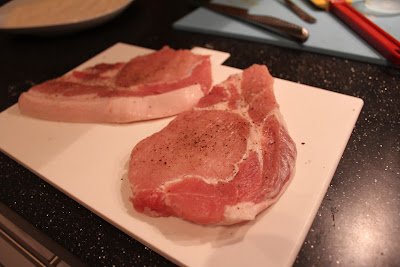
Take your pork loins and tap them firmly with the back of a knife to tenderize in a cross pattern. Then season well with salt and pepper, and push the pork loins together as the tapping will have spread them out slightly. This will ensure the katsu is tender.

Prepare your beaten egg, panko and flour in 3 bowls. Then, taking each piece of pork, dip it in the flour, the egg and the panko, then lay carefully in a frying pan with 1cm of hot oil in it to shallow fry.


The oil shouldn’t be too hot – test it first by putting the tip of a toothpick or a wooden chopstick in to see if bubbles form. If they slowly appear, the oil is at the correct temperature. If they appear suddenly and bubble violently, the oil is too hot. Fry the pork loins on both sides until golden. One tip I learned: if you are frying multiple pieces of pork, be very mindful of the temperature. As soon as the first one is looking ready, get the second one all dusted and ready to go because if you leave the pan empty while you are preparing the next chop then the oil will start to burn.


Once the pork is a nice golden brown, remove from the oil and place on a rack in the oven to dry off and crisp up.

If you wish, slice the pork into equal vertical slices and lay on a bed of rice Pour the curry over the middle of the plate and garnish with pickled red radish. Sit down, eat, and think of Tokyo.


Thursday, 27 October 2011

Devouring the Meaty Heart of Texas, Part 2

After a couple of days in Austin, you find that you are never hungry. As in, your body is never saying "please feed me, I require sustenance." In fact, it's almost continually whimpering "please, make it stop" from the first meal to the moment you step on to the plane home. And yet, somehow, we manage to find ever crazier justifications for eating quantities that would make older generations weep. The food in Austin is good, in some cases scarily good. So it's not a major leap to then say "how about having two main courses?" That actually happened. Twice.
Random truck selling Po'boys in downtown
While attending the conference last year, one of our great little discoveries was a beaten up old BBQ shack just across from the convention centre called the Ironworks. It's hardly what you'd call the best BBQ in town, but it's right next door and so every lunchtime a gargantuan queue of game developers forms within seconds of the last session of the morning talks. Since then, it's become a bit of a regular thing for us, with some crazed members of my team ending up there on three(!) occasions that week.

The thing in particular that I love about the place is the fantastically brusk attitude of the staff, which is so diametrically opposed to the standard friendly service you normally encounter in the US. Perhaps it's because it reminds me of home that I like it so much. The food is chopped and served quickly, and if you dally when you finally get to the food counter, the guy with the big knife starts to get antsy. And you don't want that. That's not the best bit though. God help you and all your offspring if you get to the cashier and you mess around. The cashier, a steely prison-warden of man behind grease-steamed spectacles, glares at your food while punching the buttons on the till like the fat kid in school. Show up, pay, move the hell on. Do not waste his time. The greatest thing to witness at the Ironworks is people skipping through the queue to go and ask the cashier a question. These people are noobs, in the common parlance, and they will get the smackdown. I know, I've been there. If you don't have a tray with food on it, the Cashier only has one response for you: "Get in the queue." Want to book a table? Get in the queue. Want some takeaway? Get in the queue. Need an ambulance? Get in the queue. I love it, particularly because you just know what's coming when some fresh-faced woman heads straight past the queue to the cashier trying to sweet-talk a table for her friends. Know what happens? She gets in the damn queue.

A standard lunch in Austin. For two (ish).
And while I've said that the food is far from the best in Austin, it is still pretty damn good as far as a lunch goes. You can get the sampler plate, as per usual with joints like this, but after several trips we've discovered that you're much better off getting a couple of pounds of brisket and sausage, and sharing it with someone. Or not, if you happen to be American. Or Samoan. You also order sides in volume, which is an awesome quirk. Want some potato salad? Want a pint of potato salad? How about a gallon of chilli? A quart of coleslaw? You know you want to. As a colleague remarked, "I could get used to this." You could, although you would end up the size of a Smart car.

These guys put on a hell of a show, every week.
Austin also has a fantastic live music scene, and in true American fashion often declares itself "The Live Music Capital of the World". Now I'm not touching that particular statement with a bargepole, but if you're in Austin then you owe it to yourself to check out a live show. I was fortunate enough last year to be introduced to a brilliant local band, the Spazmatics, who play at the Cedar St bar every Wednesday. They have played every Wednesday night for at least four years, according to my friend. They are a zany 80's tribute band, who put on an absolutely brilliant show filled to the brim with classic tunes. And yes, they play Journey. Now, no doubt their success is due in part to playing a venue that is basically heaving with drunk people, but they are also a well-oiled machine performance wise. There is a twist, however. If you google them, you will discover that they are what's called a franchise band. Not familiar with the term? Neither was I, until I saw these guys. Basically, there is a Spazmatics in every single major city in the USA. And they all do exactly the same act, but they are different guys in each one. The concept is franchised to musicians around the country, who then exectute it flawlessly. When I first learned about this, my mind was blown - surely such an entertaining act wasn't just one in a line of manufactured styrofoam casts of a single concept? I'm hardly one to get misty eyed about the romantic notion of a musician and their art in the age of Rebecca Black and Crazy Frog, but there was still something slightly unsettling about it. So I was curious about how they would fare the second time around, knowing this dark secret. And you know what? They were absolutely fantastic. Colleagues who were there for the first time were blown away, and the band killed it with exactly the same gusto and feverish enthusiasm that they had last year. The one thing I do know however, is that I don't want to see any of the other Spazmatics now. These guys are the one for me.

Before we left Austin, we also made one more new discovery: The Hula Hut. The Hula Hut is cool little tex-mex place down along the river. On the plane over from Dallas the guy sat next to me had recommended it, and Dave had also suggested it as a worthy adventure, so it seemed like a well-vouched place to visit. The place feels like a mashup between Meatballs and True Blood, all tacky hawaiian decor with faerie lights and cute waitresses. They also have a big dining hall outside, which sits above the water and is definitely the place to be when the weather's nice. This is where one particularly brave colleague of mine suggested having two mains (a feat that was then repeated by others). As a note, when an American waitress says "that's quite a lot of food", for god's sake listen to the woman. As it turned out both mains were conquered in the end, but not without inflicting massive damage on the participants. The Shiner Bock beef fajitas were delicious and succulent, and the burritos were suitably massive. They also have potentially the king of all dips: a warm queso cheese dip with chunks of chilli, tomato and guacamole plonked on top. It was heavy duty, but delicious. Among less civilized company, this dip could start a fight. Of all the things we tried however, my absolute standout was the Crispy Shrimp Tacos. I'd never had these before, and they were absolutely amazing, so it was by good fortune that a friend had actually sent me a recipe for them.


Thankfully frozen shrimp are easily obtainable and not too expensive, so it's worth giving this a try. If you enjoy mexican food but can't face any more meat, much like myself after a trip to Austin, then look no further.

Crispy Shrimp Tacos with Peach Salsa
Author: Kristina Wiley
For the Peach Salsa:
6 peaches, peeled pitted and diced (about 1 1/2 cups)
1 medium sized red bell pepper, seeded and diced (about 1 cup)
1 cup loosley packed coriander, chopped
1/4 cup finely diced red onion
1 jalapeno pepper, seeded and finely diced
1 clove garlic, minced
1-2 limes, juiced
1/2 teaspoon salt

For the Shrimp:
12-16 ounces peeled and de-veined shrimp, tails removed (about 30 small shrimp)
3/4 cup flour
2 teaspoons salt
2 teaspoons cumin
2 teaspoons garlic powder
1 teaspoon cayenne (or more if you like extra spice)
1 teaspoon black pepper
2 eggs, beaten
canola oil for frying (enough to cover the bottom of a large skillet)
additional salt

Additionally:
10 small flour tortillas
lettuce, shredded
sour cream
additional cilantro

Instructions

Mix together all of the peach salsa ingredients and set aside until ready to use.


Rinse the shrimp with cold water and pat dry with a paper towel. Now you want to set up an assembly line so you are ready to go! Mix the flour, salt, cumin, garlic powder, cayenne, and black pepper together in a pie plate. In a second dish, place the beaten eggs. Then, have a 3rd clean baking sheet ready / tray.

In a large frying pan, heat oil (just enough to cover the bottom of the pan) over medium high heat. Use the bubble test to see if the oil is hot enough: stick the tip of a toothpick or chopstick into the oil. If bubbles slowly form, you are good to go. If bubbles appear suddenly and bubble violently, the oil is too hot. Get a tray ready by stacking a few paper towels on it.

Dredge the shrimp in the flour (shake excess), then the egg wash, then BACK into the flour and coat well. Gently shake the excess off and place on the clean tray. Repeat with remaining shrimp until all are coated with the flour.

Cook shrimp in 2-3 batches (depending on the size of your skillet). You want them to cook in one even layer making sure you don’t over-crowd or overlap the shrimp. The shrimp take roughly 1 1/2 to 2 minutes per side. Cut one in half to make sure the shrimp are cooked all the way through (You do not want any clear/translucent left – you want it to be opaque and pink/white in color!). NOTE: You don’t want to OVER cook them either, so pull them off after 1 1/2 minutes (on each side) and check them.

Sprinkle shrimp with a touch of salt and set aside. Repeat with remaining shrimp until all are cooked.

To assemble: On each tortilla, sprinkle a little shredded lettuce and top with 3-4 shrimp. Spoon a tablespoon or two of the peach salsa followed by a dollop of sour cream. Top with a sprinkle of coriander. Serve with fresh lime wedges to squeeze over the top, this really brings it to life.


Monday, 24 October 2011

Devouring the Meaty Heart of Texas, Part 1

Austin is a fantastic city.

As part of my work, I am tremendously fortunate to get the opportunity to travel to various parts of the globe for business conferences and meetings. One particular conference takes us to Austin, Texas every October. I first visited Austin last year, and was immediately taken by its charms: the friendly locals, the endless buffet of live music and the veritable tsunami of great food. So my most recent trip, earlier this month, felt like a perfect candidate for a little write-up. While downtown Austin is relatively small by American standards, the greater city area still a gargantuan stretch of land peppered with little outcrops of activity, like popcorn scattered in a field. Most business trips tend to have a very localized centre of gravity (read: hotel bar & restaurant), but Austin is one of those cities that just beckons to you, the gentle hum of activity carried through the city on a flying blanket of booze and grill smoke. So I was even more fortunate to have a local friend who has been living there for a couple of years. On my last visit we went for a little road trip around the outskirts of town, and this time we decided to do the same again.


Our first stop was a pretty well-known barbecue joint called The Salt Lick. It's been featured on Man vs. Food and countless other "Top Ten BBQ" lists as a great place to visit for an authentic Texas BBQ experience. Now the really hardcore purists may argue that Franklin's has better meat, or that the 'holy trinity' down in Lockhart is a more authentic experience, but for simple atmosphere and rustic charm I love the Salt Lick. It's tucked away on an old dirt road in Driftwood, about a 30-minute drive outside of Austin. On the way, you drive past the following sights:


Now I may be a limp-wristed blue-hearted liberal from Great Britain with an exotic accent (according to most Texans), but things like this just make me smile. Dave pointed out that I find these sort of details interesting because I don't live there and am not subjected to them on a daily basis, and perhaps he's right. But there's a personality  and old-fashioned sense of courtesy around these parts that I find both alarming and refreshing after spending several decades facing down the glowering scowl of your average Londoner. It's easy to take the piss of how backwards or simple they might seem, and many do, but fundamentally these are good people. They probably have very different values to you and me, some of which you may even find repellent, but they are also incredibly kind and friendly. At least, that's my experience of them. Then again, I am hardly a raging firecracker of anti-establishment rebellion, so that might play a part.

Anyway, back to the food. The first thing you see when you enter the dining hall of the Salt Lick is the frankly mindblowing smoke pit. They actually have two, though the one in the pictures is my favourite. The cashier girl, upon hearing my crazy accent, invited me in to the kitchen so that I could get a better picture of the smoke pit, and I happily obliged. You can probably tell from the picture, but the smells coming off this thing are absolutely divine.

According to the cooks, they smoke their brisket for 24 hours, with the other smaller cuts going on for various lengths of time. As we sat down with our menus at an old wooden bench on the far side of the room, I was immediately ensconced in a laid-back, welcoming atmosphere with people eagerly ploughing through mountains of glistening, smoky goodness. As a matter of course, I ordered the sampler plate, which arrived promptly - a small Everest of brisket, ribs and sausage, piled high under a glistening blanket of their incredible barbecue sauce. I could write an entire blog post just about barbecue sauce (and maybe I will!), because they come in all sorts, tastes and consistencies. The Salt Lick's sauce is a thinner, runnier sauce with a sweet and vinegary taste that just does wonders when it hits meat. I actually brought several bottles back with me, because as I have stated in previous posts, you will never get sauce this good in the UK. The meat itself is great, particularly the sausage and ribs. Brisket seems to be the hardest thing to get right (although if reports are to be believed then Franklin's has cracked this conundrum), whereas the sausage and ribs seem to benefit from simplicity and slow cooking. The ribs in particular were juicy and soft, with the meat just disintegrating rather than getting stuck in your teeth. Special mention must also go to their bread hotdog rolls, which come as one of innumerate sides. I am a sucker for soft, squidgy bread, and this stuff is almost comically soft. I'm pretty sure mother nature never intended bread to be quite that doughy, but oh my god it is perfect for mopping up barbecue sauce. This is amply demonstrated by Dave's hilarious looking chopped beef sandwich below, which is actually made up of four hotdog rolls in a row, filled with a hellflood of chopped beef and sauce. I was endlessly entertained by the fact that it looks like the gaping maw of a meat-based doombringer, come to devour your children on some sinister revenge mission.


Normally after a meal like that, I would curl up into a ball of guilt and self-pity while sucking on the bones. However after several beers, Dave had the genius idea to ask for the dessert menu. Hey, you only live once right? (and at this pace, that is virtually guaranteed). Swallowing my immediate terror, he ordered the cobbler and I ordered the pecan pie. His cobbler looked like the site of an icecream meteor hitting the earth's crust, a steaming vat of molten fruit and sugar bubbling beneath. My pecan pie turned up, and looked like this:


Yes, that is a standard sized fork stabbing it. The pie laughs at the fork with disdain, like a goldfish attacking a whale shark. I'll leave you to eat the pie with your eyes by just saying that it absolutely shit on any pecan pie I have ever had in the UK. That probably goes without saying, but there was just no comparison between the two. Warm, crispy caramelised pecans layered on top of a slick, sugary something and a light, flakey pastry crust. This was pretty much my coffin nail, consciousness slowly drifting away from me like smoke vapours. Dave, sensing my incoming food coma, said "let's go, I need to show you something."

We jumped in the car and headed east, through a little town called Buda (pronounced "byoodah", bizarrely) filled with random trailers and shanty town storefronts. As we slid over the undulating hills of southeastern Austin, my food-addled brain took note of the several water towers dotted across the horizon, like toothpick cocktail snacks. "Is that normal?", I asked. "Those are tiny ones," Dave replied. "Wait till you see the one where we're going."

We pulled up in a typically gargantuan carpark outside what looked like a standard B&Q, a place called Cabela's. I couldn't have been more wrong in my initial assessment, however. This is no ordinary DIY store. This is a guns and hunting supermall.

Stepping inside, there is a lot to take in. There is a stuffed yak mounted above the entrance to the toilets. There is a fully camouflaged mannequin chilling out in a sniper nest. There is a rocky outcrop at the far end of the enormous store, covered in mountain goats and other killable beasts. There is a fishing section the size of a Costco. There is a goddamn aquarium. This is no ordinary store. Actually no, hold that. This is an ordinary store in Texas.

As I started wandering the aisles of excess, hunting / camping / hiking gear as far as the eye can see, I stumbled upon a little enclosure at the back of the store, where things started getting really weird.


Throughout the entire rear of the store, there were stuffed animals. Everywhere. Of every kind. Lions, tigers, elephants, water buffalo. Deer, mountain lions, prairie dogs, moose (meese?). Bears, wolves, muskox, a freaking polar bear! There was even a separate room on one side with every type of deer, squirrel and turkey I've ever seen! And that room had its very own animatronic George Bush-lookalike in hunting gear, recanting tales of early hunters and how they blew animals away with rifles. And throughout all of this, there were parents strolling around, kids in tow, looking at the various stuffed animals alongside all of the equipment used to kill them. Now don't get me wrong, I am not a hemp-wearing animal-loving hippy. I have skinned a rabbit with my bare hands at a stag party (long story), and spent time on a farm so I have no issues at all with killing animals for food. But this was a thoroughly creepy experience because of the manner in which it's aimed at children and the conveyor-belt sense of educating them for commercial purposes. See that deer? That was killed with hollowpoint ammunition from a Barratt sniper rifle while dressed in a full-body camo Ghillie Suit, sat up in your Buck Buster. And guess what? We sell all of that here.


Inevitably, we ended up in the gun section. I'll let the pictures do the talking here, and just simply say that taking pictures surrounded by people checking out fully automatic Assault Rifles and comparing scope sights was one of the most physically uncomfortable experiences of my life. When you take pictures in Texas, you get looks from a few people. When those people are holding an AK47, it's a very different look. Unfortunately the pictures don't convey it, since I wasn't comfortable picturing people buying guns directly, but this was easily the busiest section of the store as well. Men, families, daughters, grandparents. They were all here, looking at different rifles the same way you might look at a camera in Dixons. It was truly surreal.


Seeing all of these weapons, ammo and accessories lead me to an interesting reflection. I play a lot of video games where you fire weapons at people / monsters / orks, etc. So according to the Daily Mail I should be a dyed in the wool mentalist, grabbing guns off the shelf and running through the store shooting people on a GTA-style murder spree while furiously masturbating. But seeing all of this up close and personal had quite the opposite effect. Dave kept egging me on to go up to the counter and ask to see the biggest gun they had, but I wasn't interested in any way. Ever since I accidentally shot my sister right above the eye with a BB-gun as a kid, I have been vehemently disinterested in weapons. That was one of the scariest moments of my entire life, and when you see just how easy it is to inflict so much more harm with a real weapon, it actually makes my skin crawl.

Hunting, and more importantly owning a gun, is at the core of living in Texas, and nowhere is that more apparent than when you see the way in which it's been turned into a business. Seeing this in action was sobering, mildly terrifying, and deeply insightful. It would be grossly arrogant to simply assume that all of the people shopping at a place like this are patently insane. Owning a gun is a way of life here, and while the right to bear arms may no longer have anything like its original constitutional context, many people and families in the US still consider it a god-given right alongside freedom of speech and the right to a fair trial. It may be alien and strange to the rest of us, but it's a fundamental part of the patchwork quilt of the American identity and I'm glad I got to witness it first-hand.

Monday, 26 September 2011

A Saturday Feast

This past weekend I did a Saturday lunch for some friends, and it was in my mind at least, a great meal that was easy to put together. It's not overly time consuming, and meant that I didn't need to spend all my time in the kitchen while guests were over. It also made the flat smell awesome, so I thought you might like it. I'm not suggesting everyone cook this every weekend, but I think it's a great one to have in your back pocket if you need a solid meal with minimum fuss.

One thing that I specifically like about this pairing is that both of them are done in short stages, over two nights. Starting a meal two nights before you eat it might seem really strange, but it saves you so much hassle on the actual day so that you can have a drink and relax instead of slaving over the stove. And each stage takes no more than 30 minutes, so it's not like you have to spend your whole evening prepping.

Overnight Pulled Pork

I've posted a recipe for pulled pork before, which was based on a shorter cooking time. This recipe that I found online is specifically suited for an average 12-hour cooking time, so basically overnight. At first I was a bit iffy about leaving my oven on overnight, but after having done it a couple of times now I've never had any issues whatsoever. The biggest issue was the flat smelling like lovely pork in the morning, but as you can probably guess, I got over that one pretty quickly.

You'll want a 2-3 kg pork shoulder joint for this, avoid leg or loin roasts as they don't have enough fat to stop it drying out. If you can get the shoulder skinless, that will make your life easier. Otherwise simply remove the skin by carefully cutting between the skin and fat layer with your sharpest knife (giving it a good sharpen beforehand will make this a doddle). I like to roast the skin by itself in a roasting pan and then cut into little squares to nibble on during the meal.

Dry Rub Ingredients

1tbsp ground cumin
1tbsp garlic powder
1tbsp onion salt
1tbsp chili powder
1tbsp cayenne pepper
1tbsp salt
1tbsp ground black pepper
1tbsp paprika
1/2 cup brown sugar

Mix all of the spices together well and store in an airtight container. This should give you enough spice rub for two roasts.

Brine Solution

1 litre water
1/4 cup salt
1/4 cup brown sugar
2 bay leaves
2 tbsp dry rub mix

Add the salt to the cold water and stir very well until it's completely dissolved. Then add the brown sugar, dry rub and bay leaves, stirring to combine. I find doing this in a saucepan makes the next step easy.

Rinse the pork shoulder well, then place inside a big ziploc bag. Pour the Brine Solution into the bag, making sure that the pork is completely submerged. I find the best place to store this is in the fridge door, so shift some bottles to make room for it. That will keep the pork standing upright and ensure it stays submerged. Leave to brine for a minimum of 8hrs, I simply leave it in there until the next evening. Do this while you're boiling the potatoes for the potato salad (see the recipe below).

Preheat your oven 105 degrees Celsius. You read that right. This is a real 'low and slow' recipe, but don't worry, do exactly as it says. The first time I tried this recipe I upped the temperature just a little bit thinking it was insane, and ended up scorching the meat. So keep it low.

Remove the pork from the brine solution, pat dry with paper towels to get rid of all excess moisture. Plonk the meat in a big roasting tin and sprinkle dry rub over the entire joint, patting it with your hands so that it sticks. Once the whole thing is coated, I like to add an extra layer of brown sugar on the top to give it a lovely caramel crust. Make sure the fat layer on the pork is facing up, and shove it in the oven.

Come back 12 hours later and marvel at the wonders that have taken place. Your pork should look like a molten ball of awesome, and smell divine. If the bottom of the pan is dried out, add a bit of water and scrape the bottom of the pan with a wooden spoon - that stuff is phenomenal when drizzled over the pork. Remove the pork from the oven and cover with tinfoil. Let it rest for two hours - it will still be nice and hot when you serve it, resting it just helps moisten the meat. Shred with two forks and add barbecue sauce as you wish - either toss the meat into buns with coleslaw, or just have by itself.


One thing that I have learned: this pork will automatically have people asking for seconds. So save yourself some stress and shred the entire joint at the same time. It may seem like a ton of meat, but trust me, it will get eaten. And it's much easier to shred when it's nice and hot than once it's cooled down.

Incredibly Moreish Potato Salad

Potato Salad is a tricky thing to get right. There are many different types, most of which can quite simply be boiled down to a combination of potatoes and mayonnaise. The stuff you get from most supermarkets tends to be potatoes swimming in a sea of goop, no matter how classy the establishment purports to be. I've tried a couple of different recipes, but have never really been satisfied. Many "gourmet" recipes, like Jamie's for example, suggest things like fromage frais, olive oil and lemon, and if I'm brutally honest I'm slightly puzzled as to the kind of people that would like that sort of thing. It came off as rather bland and limp, with very little to make it stand out.

Perhaps it's because I have quite a lot of American influences in my palate, but when it comes to potato salad I want the stuff you get at barbecues. I have an instinctive association between good potato salad and grilling, where the salad is a crunchy, snappy retort to the charred meaty advances of a raging barbecue. Especially in England, where barbecuing seems to be a synonym for meat immolation, a solid creamy potato salad is a lifesaver.

So when I was coming up with the menu for saturday lunch this past weekend, I wanted a great potato salad to accompany my 12-hour slow roasted pulled pork. I looked in all my cookbooks, but alas, all of their suggestions struck me as too frilly and fancy. I needed something more unassuming, rustic and for lack of a better word, authentic. I trawled through various BBQ websites and stumbled upon one that looked epic, but seemed to do exactly what I wanted. It also contained some hilariously unassuming ingredients, which I'm a sucker for. I figured that my pork was going to be good enough to hold up no matter how it turned out, so I chucked the recipe into Evernote (a cook's best friend), and headed to the supermarket. Let me tell you right now, I hit the jackpot.

As with any recipe, you really can make this your own if you like it a different way. I made several adjustments for an English shopper, but this version turned out absolutely brilliantly. Personally I can't stand boiled eggs, and bacon seemed like total overkill but these are just two examples of things you can add in if such is your fancy.

The key thing for this recipe is that you start preparing it two nights before you want to eat it, just like the pork. That may sound like a lot of work, but it really isn't. Each step is very quick, and the results are 100% worth it. Do the pork and the potatoes together and you will have a fantastic meal.

Ingredients for the Salad
  • 1kg new potatoes (I prefer Charlotte for their firm, waxy texture)
  • 6 spring onions
  • 3 stalks of celery
  • 2 radishes 
  • 5 gherkins (buy ones in sweet vinegar)
  • 1/3 cup of mayonnaise
  • 1/3 cup of creme fraiche
  • 1/2 tsp celery salt
  • 1/2 tsp salt
  • 1/2 tsp freshly cracked black pepper
  • bunch of flat leaf parsley
  • paprika (optional, for colour)
Ingredients for the Vinaigrette
  • 1/4 cup of sweet vinegar gherkin juice (I know, trust me)
  • 1 tbsp of your favourite mustard
Two nights before you want to eat the potato salad, put all of your potatoes into a pan and cover them with an inch of water. You can either go skin on or off in the salad, but when you are boiling the potatoes make sure you leave the skins on so that they don't absorb too much water. Bring the water to the boil, then reduce heat and simmer for 15ish minutes or until the potatoes are still a little firm. Poke one with a fork - if the fork goes in and out easily, they're done. Don't freak out if you cook them a little bit too long, it won't hurt the salad.

Drain them thoroughly, then slice into 1/2 inch chunks while still hot. If you want to remove the skins do so now, but be warned it can be a real pain. Personally, I prefer leaving the skins on - partly for flavour, partly because I cannot be arsed peeling every single hot potato by hand.

Chuck the sliced potatoes into a bowl, and while they are still hot, season them with salt, pepper and the Vinaigrette. The vinaigrette should be fairly watery, but don't worry about it - the hot potatoes will soak up all the lovely vinegar flavour quite happily, and you really can't go wrong with seasoning at this stage. Cover the bowl tightly in clingfilm and store the potatoes in the fridge overnight. This particular step may seem like overkill, but it will make a huge difference in the quality of your potatoes. I was personally skeptical at first, but when I tried the potatoes the next day, they were good enough to eat on their own. After leaving the potatoes to soak up the vinaigrette/seasoning overnight, make the rest of the potato salad.

Thinly slice the spring onions, celery and radishes. Dice the gherkins into small chunks, and throw all into the bowl with the potatoes. Add the mayonnaise, creme fraiche, celery salt and salt/pepper. Mix the whole lot together with a spatula and taste. Resist the temptation to eat the whole thing right then and there. We came alarmingly close to doing this. Cover the salad again and put it back in the fridge. Tomorrow it will be ready.


Right before you serve, garnish with freshly chopped parsley and a sprinkle of paprika for colour. If you like hardboiled eggs in your salad, add them here. Keep the potato salad cold, and go to town. I can testify that this is a perfect companion to a pork roast, though it would kick ass alongside chicken as well. Bring this along to a barbecue (make sure you keep it cold throughout) and you really can't go wrong.

Thursday, 22 September 2011

Finger Food

This past weekend, I discovered two things: that there is such a thing as a free lunch, and that you should never take your eye off the mandoline when slicing cucumbers at recklessly high speed. Both of these resulted in a titular state of affairs, but with staggeringly different enjoyment levels.

Not a musical instrument, unless
you consider 'aaaarggjgh' music
While I won't indulge the gorehounds among you with every minute detail of my little accident, I will just say that it has thoroughly driven home the sheer number of things that you use your thumbs for. Typing this post alone was a bit of a pain in the ass (metaphorically speaking) and everyday tasks like getting your bloody wallet out of your back pocket are suddenly an exercise in delicate maneuvers, as if someone had mischievously snuck a mousetrap into your jeans for a laugh. Still, frantic panic-bandaging and a hilarious number of first-aid supplies later, and all is on the mend I am happy to report.

Instead, I thought you might like to hear about my little trip to Harvey Nichols Fifth Floor Restaurant, for the Sharpham Park afternoon tea promotion. As part of British Food Fortnight, head chef Jonas Karlsson has adeptly put together a lovely collection of mini-sandwiches and sweet treats, with a little bit of a twist. Instead of using normal flour, he's using Sharpham Park's spelt flour, which has a denser and nuttier texture and is apparently easier to digest. I was very kindly invited along to sample this little excursion, and given that I can't remember the last time I actually had afternoon tea, I leapt at the opportunity.

In a funny way, afternoon tea has always felt somewhat old-fashioned to me. An occasion marked with lashings of cream and grandmother's pearls, draped in the embrace of freshly-brewed tea and cucumber sandwiches. Like a quick glimpse back to the turn of the century when social gatherings were largely more civilized and slightly less drunken. It also seems like a much more feminine encounter, where girlfriends swap gossip or mothers collectively plot their next campaign for their children's hearts and minds. It's not quite the territory of burly men discussing the transfer market, let's be honest. Nonetheless, on the back of my experience on Saturday, I think it could enjoy a healthy new lease of life. Whether you're there with friends, family or a loved one, there's actually a lot to like about spending a bit of time on a rainy afternoon munching on delectable treats. Not only do you get a brief, fleeting injection of civility into everyday life (where I mostly shout at tourists on the tube), but you also get to feel a bit like a giant eating tiny little sandwiches.


The Fifth Floor restaurant is a modern, sleek affair, with warm and welcoming browns and beiges (you can tell I've been decorating recently). It's a nice big open dining room, which gives the whole place a relaxed, chatty vibe. The service was absolutely impeccable, getting that rare balance in London between being charming and friendly, while also leaving you alone long enough to actually enjoy your meal and company (take note, Shoreditch establishments: asking if everything's ok every four minutes is not good service). One immediate thing that I appreciated was that even though the clientele is clearly on the wealthier side, there was no snottiness on the part of the staff towards me taking photographs of the food. This is something that american waiters do brilliantly, and it's nice to see behaviour like this prevail in a place where some might turn up their nose at my plight. This was further reinforced by the Japanese group sat behind us who produced a real-time photo catalogue of every single element of their entire meal. And no, I'm not stereotyping here people.

The Coronation chicken was switched to Roast Beef on the day

After choosing our teas (Earl Grey for her, Darjeeling for me) with all the panache of a blind man in a stripclub, they brought out the sandwich platter. Each little sandwich was lovingly crafted, as if they had been built by pixies on miniature scaffolds. The Smoked Salmon bagel, for example, is deceptive in the photo because it was actually about the size of a large walnut. It was here however, that my first surprise lurked. As with most food, I tend to save the best bit for last. This always used to be my downfall as a child, where I would save my crispy bacon for last and then my dad would nick it under the auspices of not wanting it to go to waste. So I decided to leave the Roast Beef focaccia for last, and start with the Egg Mayonnaise. Imagine my surprise, then, to discover that the Egg Mayonnaise sandwich was actually the standout. The egg itself was perfectly seasoned with the chives and cress giving it a hearty, herby backbone, and the bridge roll was crispy and soft. I was thankful that it was the biggest of the bunch, because it was undoubtedly the best.


The Bocconcini was also lovely, two bites of perfectly balanced tomato, mozzarella and toasted sourdough. The sourdough also had a nuttier flavour, thanks to the spelt, and enough substance to comfortably hold it's toppings without fail. I am a huge fan of smoked salmon bagels, so it's miniature cousin was eagerly anticipated. While the density of the spelt bagel was more than I'm used to from my soho bagel man's sesame seed versions, it worked well thanks to the thickness of the salmon and the restrained layer of cream cheese. So it was with relish that I arrived at the final sandwich, a Dedham Vale roast beef with horseradish cream on focaccia. Unfortunately, despite looking all the world like a winner, the foccaccia was excessively dry and immediately sucked all of the moisture out of the beef and the cream, leaving me to swallow a rather crumbly, monotonous lump. The beef is undoubtedly of high quality, so a lighter and less aggressive bread base would have been superb.

It probably seems at this stage like I have microscopically pored over four mouthfuls of food, but that would be rather unfair. While the sandwiches themselves were smaller, they were expertly crafted and surprisingly filling. I certainly wasn't looking around fervently for a BLT, as you occasionally get in joints where the food has been downsized in favour of quality ingredients. Which is a good thing, because the real winners of the afternoon tea came on the next platter.

Your eye should naturally be drawn to the thing that looks like a confectioner's Troll Doll. Mine certainly was. So once again, I decided to leave this little beauty for last. Instead, I turned my attention to the scones, and proceeded to cover them in a near-fatal amount of cream and jam. Interestingly, the scones are really where the difference between spelt and normal flour is most apparent. These scones were slightly denser, darker and more hearty. The nuttiness also had a slightly bitter aftertaste, which mixed nicely with the sweetness of the cream and jam. Washing this down with a glug of tea hit my inner nostalgic lobe (this is its medical name) like a lightning bolt, and was a definite highlight.

The awesome little cake in the background that looks like a miniature Mr. Whippy was the amazing Hazelnut Sponge Cake. The tower of cloud-like icing contained within it a small oasis of unctuous hazelnut essence, bringing both halves of the cake together like a nutty hadron-collider. This was swiftly followed by the Sour Cherry tart, which was nice but somewhat pedestrian - nothing especially memorable about it, although I was impressed that they'd managed such a soft and sticky texture with such a stronger flour. Anyone that has discussed cake with me before will know that I am a big afficionado of the battenberg, particularly as the pastry chef at our work canteen makes an absolutely monstrous battenberg slice that you could build forts out of. So my curiosity was piqued by the tiny little windowpane, wrapped in ruby red marzipan. It almost seemed like a treat straight out of Alice in Wonderland, a fiery remnant of the Mad Hatter's tea party. Interestingly, it was much more restrained than I expected and not overly sweet which is a welcome measure when dealing with marzipan. Its wilder and more raucous relative was definitely the Passion Fruit Pavlova with popping rocks. Cracking the exterior of this little blob revealed a sunburst yellow gooey centre, which transformed into a reassuringly fizzy mouth-party once the poprocks got to work. Childish, fun, and hugely refreshing.

And so it was that I finally came to the green-haired monstrosity that was left remaining on the platter, like a surly bouncer with a silly wig. I'm not entirely sure what a palet au chocolat actually is, but in simple terms it was a rich chocolate mousse encased in a hard milk chocolate shell, all draped in a colourful green candyfloss swirl. Now the candyfloss itself was amazing, practically sublimating the second I tasted it, and the chocolate was lovely, mild and not overly acidic. The one rather funny thing about this particular treat was the fact that as I continued to dig into it, the candy floss mixed in with the chocolate and I was eventually looking at a rather hairy chocolate mess. Something akin to a Chia Pet homicide, if you will. It tasted amazing, but it might be somewhat alarming to those of you with a more fragile disposition.

All in all a tremendously enjoyable afternoon. I'd highly recommend it to anyone that's a fan of afternoon tea, or even if you're just looking for a different place to catch up with an old friend. Whether you're just retreating from the horrors of weekend tourist shoppers, or just spending some time with your parents, this is a perfect place to enjoy an afternoon at a much more leisurely pace.

Friday, 16 September 2011

Cooking the Purist's Carbonara

A real Carbonara should not contain cream.

That's a slightly harsh take on it, but it's widely considered the purist's take. It should be a marriage of three simple products: eggs, cheese and pig. Somehow, somewhere, cream crept in to the picture like an insidious pair of training wheels. I assume this happened because getting the consistency of the eggs just right can be hard, and requires fairly precise timing and control. Some might even get squeamish at the idea of slightly undercooked eggs in their meal (even though this is actually not as much of a health risk as they might think). Some believe that the cream is simply a regional thing, where subtle shifts in the landscape and palate nudged experimentation along different paths. I'm all for making something your own, although that still doesn't excuse the abomination that the Americans have turned it in to (I'm looking at you, peas). Whatever the reason, there is only one kind of Carbonara for me, and that's the one I'm going to write about.

The actual origins of the name Carbonara are typically mysterious, though theories abound. The most commonly held theories are unsurprisingly discovered on Wikipedia:
Like most recipes, the origins of the dish are obscure, and there are several hypotheses about it. As the name is derived from carbonaro (the Italian word for charcoal burner), some believe that the dish was first made as a hearty meal for Italian charcoal workers. The etymology gave rise to the term "coal miner's spaghetti", which is used to refer to spaghetti alla carbonara in parts of the United States. It has even been suggested that it was created by, or as a tribute to, the Carbonari ("charcoalmen"), a secret society prominent in the unification of Italy.[13]
It's a rich, sumptious and surprisingly filling dish, so I can totally understand the association with coal miners. Regardless of its origins though, it's similar to most other classic Italian dishes in that there is no one exact way to prepare it. You can find hundreds of recipes for bolognese (hint: the best ones use milk and white instead of red wine), and arguments rage across Italy and the rest of the world as to how to make the perfect version of any of their dishes. Even my beloved Silver Spoon, that weighty tome of simple, authentic Italian cuisine, cannot claim to hold the definite article in many cases. For me, I grew up with my mum's version of carbonara which was farfalle in a cream sauce with bacon. I know, I know. But it was her version, and she did it well, just like many of our mums. In fact I still like her version today, I just don't think of it as carbonara. Why? Because I've had the purist's version, and quite frankly they bear almost no resemblance at all.

The best Carbonara I have had to date, was at a traditional roman restaurant called Perilli, in the Testaccio district of Rome. I actually first went there this summer, while visiting dear friends of mine who now live in Rome and who have appropriately scoped out some of the best eateries in town. I had heard from them that this place does the best carbonara on earth, and while I had cooked the purist's carbonara myself before, their version was indeed superior on every front. The sauce was a luscious golden yellow, the pasta a perfect al dente the way you can only really get in Italy, and the cheese perfectly balanced and blended. It was immediately obvious to me that this dish was the culmination of decades of practice and refinement. You could practically taste the thousands of hours that have gone into mastering this one single dish. And as a cook, one of the things I love the most about this particular recipe is that your work is never done. It can always be better. There are always little things to tweak, to improve. Even now, when I made this recipe most recently, I rabbitted on to my girlfriend about how to try and get it even closer to Perilli's masterclass. Thankfully, while it will take many more moons to master the fine details, I took one giant leap forward when I discovered the secret ingredient: Guanciale.

Literally translated as "pillow", guanciale is basically smoked pig's cheek. It is almost entirely fat, with a small line of meat running through it, like the pig equivalent of a credit card. It's made by rinsing the pig cheek in red wine, seasoning it with salt, pepper and spices, and then leaving it to marinade and cure for 40 days. After that it's basically good to go, and pretty much never spoils. It has a much stronger, meatier taste than pancetta, and a depth and smokiness that comes from the delectable fat. I was lucky enough to find some when I was in Italy this summer, so I brought it back.

I should mention at this stage that guanciale is not easy to find, even in Italy. I've certainly never seen it in London, but never fear - decent pancetta makes a fine substitute. It doesn't quite have the richness or unique texture of guanciale, but it's a massive improvement over standard bacon (especially in the UK). So go with what you can find.

Purist's Carbonara

This is an incredibly simple dish, but it requires a bit of practice to get it exactly right. I've combined a couple of different recipes that I've found online into one that works for me, but even I will occasionally screw it up a bit. Keep at it, and for god's sake don't give up if you mess it up the first time. Eventually you'll be able to enjoy a hearty, simple meal that you can whip up in a flash with just a few basic ingredients.

Ingredients

500g pasta (linguine, spaghetti and rigatoni are my favourites for this)
150g guanciale or pancetta
3 cloves of garlic, finely diced
1/2 cup of parmesan cheese (avoid grated cheese like the plague, buy a chunk. You will use it, trust me)
1/2 cup of pecorino romano
2 eggs
Salt and freshly ground black pepper

As you can see from the picture, this is a pretty simple dish to prepare. The trick is all in the timing, so plan accordingly and get everything prepared first. Get everything sliced, diced and prepped and have it ready to hand. I find this dramatically reduces any stress while cooking, and for this dish in particular you just do not have time to be prepping anything while you're cooking. Getting everything laid out and ready also lets you feel a bit like a professional chef, with your very own mise-en-place. Believe me, it will make your life easier.

Put a large pot of water on to boil, be generous with the water so that you can deep boil the pasta (a little tidbit I learnt from the French Laundry cookbook my friend showed me). Add a punch of salt and dash of olive oil.

While the water's coming to a boil, cut the guanciale into small cubes ('lardons'). Don't make them too thin, you want a little bit of substance there. About the size of your fingernail should do.

Grate the pecorino and parmesan into a bowl (or shave it, if so inclined), and whisk the two eggs into a separate bowl. Mince the garlic and have it ready.


Garlic goes in.....
A little side note: if you use garlic anywhere near as much as I do, I heartily recommend my favourite kitchen gadget: The Garlic Zoom. It's basically a little car filled with razor blades, just begging to dice your garlic for you. So instead of ruining your best knife dicing, chuck the cloves inside the car, drive it around your counter like a 5yr old, and hey presto, finely diced garlic. You can even make the sound effects if you want.

As the water comes to a boil, put a frying/saute pan on medium heat, add a small glug of olive oil, and chuck in the guanciale. Pop the pasta into the water and set a timer (generally between 8-12 minutes, depending on the pasta). Keep the guanciale moving around every so often, and let the fat start to render. If the fat becomes too much and the guanciale is literally swimming (which is entirely possible), spoon off the fat into a jar for safekeeping - that stuff is gold dust. Make sure you leave a couple of tablespoons of fat in the pan.

Here's where the timing gets important, so focus. One minute before the pasta is ready (taste the pasta to check doneness), turn the heat down on the guanciale and throw the garlic in. It will brown very quickly, so keep it moving. Turn the heat down to a minimum once it's golden to keep it warm.

Now before you strain the pasta, get a half-cup of the pasta water and put it to one side. Drain the pasta, and toss into the guanciale pan. Add the pasta water, and mix it all together.

Now take a large bowl (salad bowl is the best option I find), and pour the eggs and the cheese in. Whisk them together, then dump in the contents of the guanciale pan. Mix everything together vigorously for 1 minute - the egg should form a lovely, smooth consistency, and all the pasta should be coated and glistening in lovely cheesy egg sauce.

Season with some freshly cracked black pepper and a tiny bit of salt, and serve. Eat immediately.